
From Awareness to Action: How Small Communities Can Influence Decision-Making at Any Level
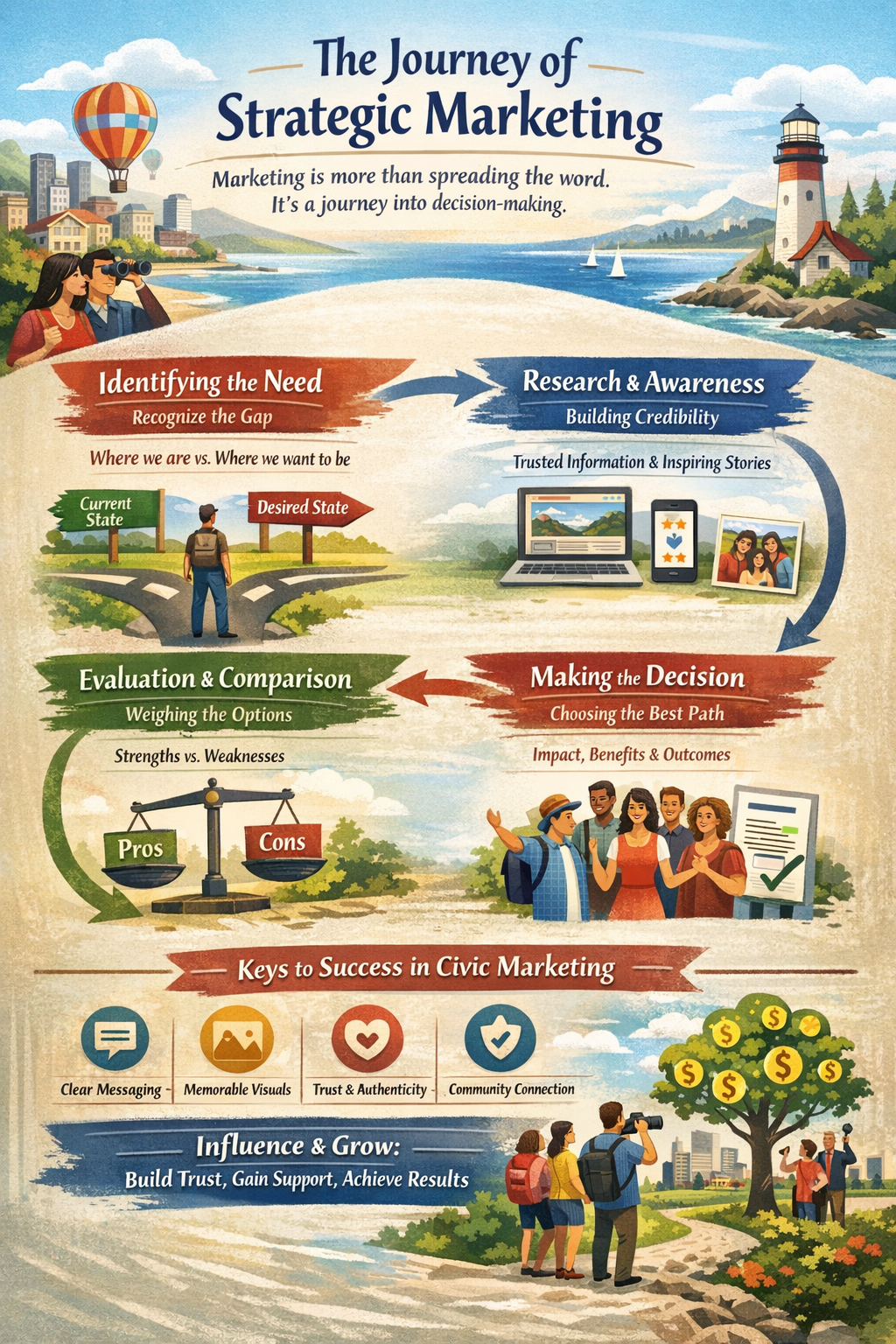
Strategic Marketing Journey
Tourism boards, city governments, and grant administrators often think marketing is just about spreading the word. Nevertheless, through learning about buyer psychology, there will be an even greater truth to uncover: marketing is more than a process. It can be viewed as a journey of audiences together with decision making.
The internal decision making process is considered progressive, and it begins with the audience identifying the need. This also means that they acknowledge a gap between what they currently have and where they desire to be. Then from here, it is important to define this gap clearly, which can be achieved through strategic messaging. For example, when dealing with a special travel experience, a travel board may make use of strategic messaging by positioning the destination as the ultimate destination, offering them an easy to navigate and understandable, travel experience.
After creating this awareness, the information now goes into the search phase. At this point, it is important to have credibility. The research suggests that people use memory, instead of referring to external sources, such as other people, reviews, or testimonials, to make an evaluation of services and products. This demonstrates the importance of credibility through a consistent story, a powerful internet presence, and a true social presence among the smaller society. These may be done with the help of such factors like a clean, closed site, representative and high-quality images and graphics. As well as real-life stories of the community. This can play a great role.
Then, people pass through the evaluation stage, during which they evaluate their situation and compare it with some standards. This is especially true when dealing with city dealers or grant writers who are struggling for scarce resources. In this case, people will be able to prepare proposals and marketing campaigns based on their knowledge of their current audience. For example, they can be informed by their understanding of whether their audience uses typical rules, including strict cutoffs or strict evaluation, which can also includes strengths vs weaknesses. Such strengths are connections with the community, measurable outcomes, and benefits to the economy.
Additionally, information processing and memory are significant. Traditionally, audiences always get large amounts of information at the same time. This is why they only remember information that easily attracts their attention, is easy to understand, or is emotionally significant to them. This means it is important to create precise information, strengthened by strong images or stories, to increase the chances that the audience will remember it and, therefore, make a decision based on it.
In conclusion, this demonstrates, as a whole, that great civic marketing can not rely solely on promotion. It should be significant enough to influence the perception of audiences involved, trust in the community, and influence the feeling of great decision-making at different levels of an organization. This is all summarized in the learning process. The capability to make decisions is highly likely to result in the opportunity to obtain funding, attract more visitors, and be able to grow in the long run.
