
Why Your Brain Has Already Made Up Its Mind About You: Attitudes, Persuasion, and What That Means for Your Community
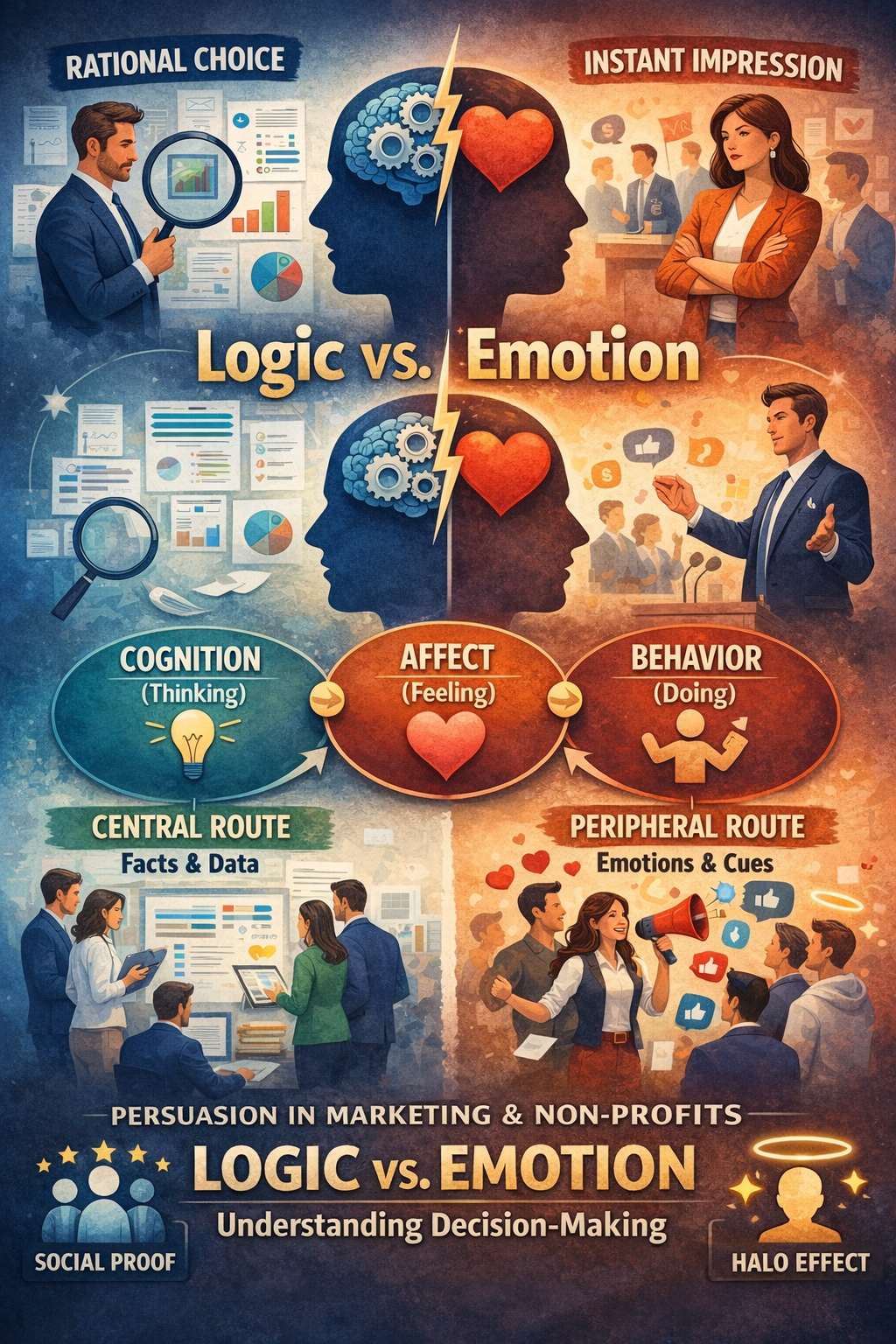
Many believe that we all rationally decide when we make decisions, after researching the options available and weighing each option carefully and then making a logical decision. However, regardless of whether you are working on a non-profit campaign, proposing a community initiative, or developing your own brand as a marketer and the truth is that your audience has likely made an opinion about you before you even complete your first sentence. The process of determining how that happens is not simply educational; it is the difference between creating a message that inspires people to take action versus having your message completely ignored.
An attitude is typically thought of as a learned response toward some object, person, place, etc. Attitudes are also referred to as relatively stable evaluations that develop over time due to past experiences, exposure to information, and social influences. This concept affects community-based organizations and non-profits significantly. The individuals you are attempting to reach such as potential donors, volunteers, and other local stakeholders, already possess attitudes regarding organizations similar to yours, causes similar to yours, and leaders similar to yourselves. Therefore, your task is not to begin at "ground zero." Rather, you need to determine where these individuals currently reside and connect with them.
The Tricomponent Attitude Model explains how attitudes consist of three dimensions: cognition (what people know), affect (how people feel), and behavior (the actions people take). Although these three dimensions exist separately and do not necessarily correspond to one another, a community member may intellectually agree with your organization's mission; however, he/she may not physically participate by volunteering. Similarly, a young professional may emotionally respond positively to the messaging you use; however, he/she may be hesitant to contact you. It is primarily the disparity between feelings and actions where many community-focused and non-profit marketers fail and it is necessary to apply a deliberate strategy to close this gap rather than simply relying upon a well-designed message.
This strategy begins with identifying the Elaboration Likelihood Model. When your target audience possesses significant interest in the topic or cause, for example, a parent concerned with issues impacting their neighborhood or a professional seeking entry into his/her industry, they tend to use the Central Route. In using the Central Route, they seek substantial evidence and credible data supporting the argument being presented. When engagement levels are low, the Peripheral Route becomes operational and decisions are made based on superficial characteristics such as how attractive or polished the visual branding appears to be, endorsements from respected individuals, etc. By knowing which route your target audience uses provides clear direction for framing messages accordingly.
For those who are unfamiliar with marketing concepts, this is one of the most quickly applicable models you will utilize. This model clarifies why a visually appealing social media posting can outperform a comprehensive report detailing outcomes and why a respected individual within your community endorsing your efforts can produce a quicker shift in perception than any paid advertising campaign. Developing a high-quality message is not about simplifying ideas; rather, it is about adjusting your communication approach so that it corresponds to how your audience is actually processing information in that particular moment.
In addition to being the constantly connected consumer, including your community members, donors, and collaborative partners, today’s target audiences are exposed to an enormous amount of content on an almost constant basis. To cut through the clutter requires understanding how cognitive biases are influencing the decisions of your target audiences. The Halo Effect indicates that your overall personal brand reputation in one domain can transfer positively across domains, if you demonstrate consistency and credibility in one aspect of your life, people will generally assume competence in others. Whether your request comes across as an opportunity or obligation depends entirely on how you frame the request. Social proof illustrates that people rely heavily upon the actions taken by others prior to deciding whether or not to take action themselves.
For civic-minded marketers, the primary takeaway here is that persuasion is not about coercion; it is about connection. When your message resonates with an existing attitude held by your target audience, believing in community, wanting to generate positive impact, needing to associate with something meaningful — it not only informs but motivates.
And now you have the tools and knowledge to accomplish this purposefully!
